Electrical energy is a form of energy and it can be obtained from other existing forms in the world, by means of a transformation. It is produced by the movement of electrons by the effect of the potential difference and circulates through a physical element called an electrical conductor. Electrical energy can be stored directly or it can be stored indirectly, as another form of energy available by transformation.
Basic Concepts on Stored Electrical Energy
- Charge Cycle: is the period of time during which an equivalent electrical energy storage medium reaches its full charge.
- Storage Capacity (Whr): The amount of energy available in a storage medium after a charging cycle is completed.
- Depth of Discharge (DOD): is the maximum possible discharge of a storage medium measured as a ratio to the storage capacity:
DOD (%) = Storage Capacity (%) - Stored Reserve (%)
- Discharge Time (td): is the discharge period measured in minutes or hours, from the instant at which the stored energy is transferred to an external load. The external load is defined by the peak electrical power consumption (in Watts). The reserve is the amount of stored electrical energy that we wish to keep in the storage medium.

- Duty Cycles or System Durability. It is the number of charge and discharge cycles offered by an energy storage medium, during a given period of time (years).
- Technical Efficiency (Eff): It is the technical ratio between the maximum energy released or discharged and the maximum energy stored in the storage medium.

- Load Efficiency (Efc). It is the ratio that measures the charge rate that an electrical energy storage medium can achieve. In theory, it is possible to store 100% of what is received, but due to material defects, only a percentage of this ideal value is reached.
- Operating Temperature (T°). This is the normal design operating temperature of the storage medium. This is given in an operational range, outside this range, it is possible for the storage system to become unstable.
Electrical Energy Storage Uses and Applications
Electric energy storage technologies are developed under three criteria:
- Technology availability
- Economic analysis
- Environmental impact
These applications can be divided into:
- Isolated applications: they are generally of low electrical power, industrial, residential use not connected to the conventional electrical grid.
- Medium Applications: They allow the supply of electricity to small cities, large industrial centers, mining centers, etc. They can usually be associated to the conventional electrical grid.
- Grid applications: These are installations that are applied to an electrical system connected to the conventional electrical grid. It is used to complete the energy demand (peak shaving).
- Control applications: They are applied to large electrical systems, especially on the generator side. They are used to correct network faults when there are load unbalances and energy injection into the network.
ENERGY STORAGE - METHODS
- Battery Energy Storage Systems- BESS is a complete integrated and assembled package. The equipment is supplied in a housing or cabinet including the inverter, the battery system, the battery management system, the protection device and any other component necessary for the correct operation of the system.

The BESS system is composed of batteries, these can be Lithium or Conventional. Additionally, a BESS container can integrate:
- Control System
- Fire Protection System
- Security System
- Electrical transfer panels for
- Input/output electrical panels
- Bidirectional Inverter
- Communications system
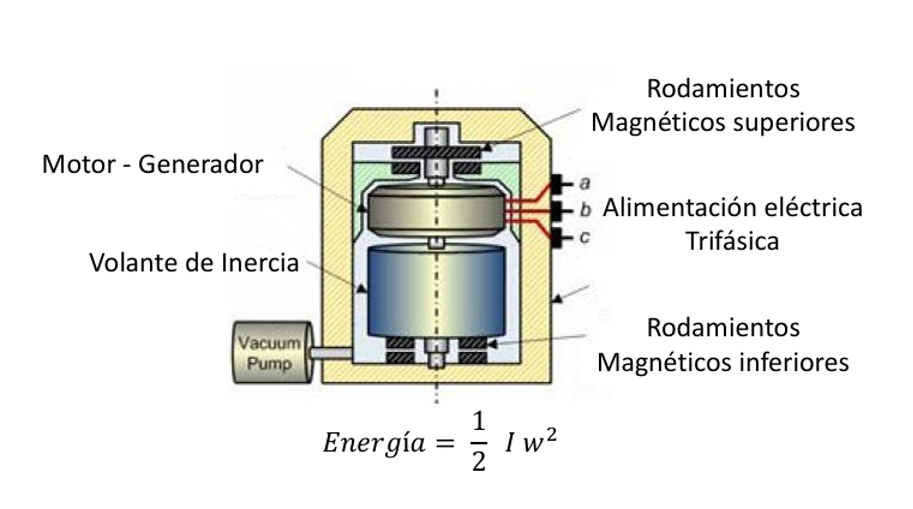
2.Mechanical Flywheel The flywheel is a heavy wheel connected to a motor generator, this wheel accumulates potential energy in the form of motion (angular velocity = ꙍ) and when a conventional electrical system is cut off, the flywheel returns the kinetic energy to the generator, to generate electricity for a very short period of time.
3. Superconducting Magnetic Storage Systems- SMES
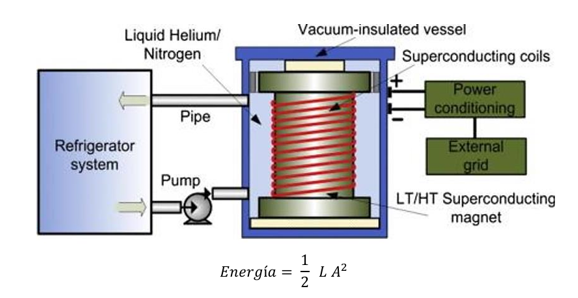
This method stores energy (EL) in a large coil with electromagnetic induction capacity (L), this occurs when the coil operates at very low temperature (in cryogenic liquids). The amount of energy stored can be very large, but the reserve time is very short. The coil delivers electric current in amperes (A).
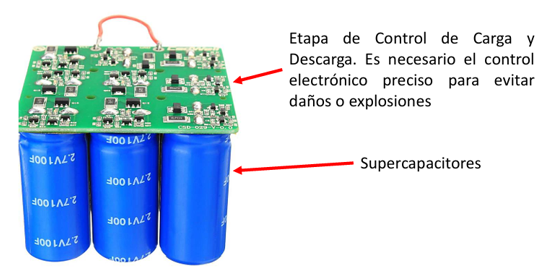
Ultra capacitors or electrical Supercapacitors
They are similar to conventional capacitors, but are different in their application, since they are oriented to the storage of electrical energy. There are several types, the best known are the double layer capacitors, also called EDLC (Electrochemical Double-Layer Capacitor) and the Ultracapacitors based on polymers (which use pseudocapacitance) to store electrical energy at low cost.