
A relatively small industrial facility has electromechanical machinery that performs certain functions that are part of the manufacturing processes. A metal-mechanical workshop that produces cabinets, enclosures, boxes, for uses in the construction sector and electromechanical installations, has many motors that operate continuously within the 12 hours of the day.
Typically, small industrial installations have a branch from a zonal substation through a transformer that feeds several users in a zone. These transformers use subway connections to distribute the power supply to each user.
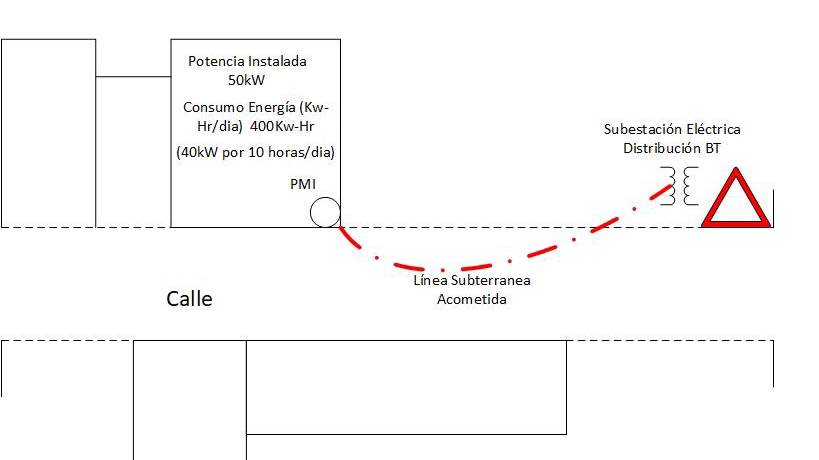
The power supply at the PMI (outdoor measurement point) is usually limited, these restrictions are given, among other technical reasons, by:
- Electrical energy carrying capacity of the conductor cable
- Subway pipeline capacity
- Distribution transformer power capacity
- Distribution substation design capacity
Thus, the limitations of the electrical installations for the industrial property are 50KW of power, in three-phase low voltage. The small industrial workshop has machinery and equipment, including lighting systems and auxiliary services for 40kW, whose daily operation is for 10 hours.
Increase in Load.
The shop will receive new equipment (including modern AC Driver motors and automatic CNC boards) with an estimated daily power consumption of 100 kW-hr/day, operating 4 hours per day and with a power factor close to unity, due to the use of AC Drivers. This equipment will work in conjunction with the existing machines to improve the current process. They operate at 380V (AC) three phase.
Then we have:
Power (kW) = 100kW-Hr / 4 Hr = 25kW of new capacity to be installed (the effects of reactive power are neglected, due to the use of AC Drivers that compensate the power factor to the theoretical unit).
The main problem is the extension of the electrical installation, which technically forces to derive the connection from another existing substation (extending the distribution substation and its transformer can be very expensive if the required power is only 25kW), this alternative can take a long time and this extension may even have to be programmed within the growth plan of the electrical network of the concessionary distributor and will take no less than 3 months or more.
For the small industrialist the installation is very critical, he has new equipment, whose financing cost is already being paid and this equipment is not yet part of the production processes.
The Alternative in Battery Systems.
One of the facts in the workshop is that they only operate 10 hours a day, so they have 14 hours available that they are not using the power supply. The shop could operate this new equipment on a special schedule, but this is not possible because the new machinery operates in conjunction with the established daily processes.
Another alternative is to use an electric generator set to provide the 25kW required, but this represents a cost of mechanical installations, operating costs and increased noise and pollution levels in the workshop.
What if we apply clean energy storage technologies?
Indeed, it is possible to have a new passive technological means of energy storage, which can use the existing electrical system and does not require major modifications to the installations, only adaptation to the installation of the new equipment.
The Lithium Ion Battery Bank System
The best alternative for this workshop is to use a lithium-ion battery bank for electrical energy storage (BESS = Battery Energy Storage Systems).
The BESS system is composed of:
- Lithium-ion cell grouping (battery)
- Built-in battery management controller (BMS = Battery Management System)
- AC/DC/AC three-phase charger/inverter, with charging time control and battery discharge limitation.
- Automatic Transfer Board
The power required to be installed is derived from the energy required to be stored over time (t). If we consider daily utilization, our time range is 24 hours a day, where we assume that there are no power outage phenomena (if the power is cut, all production stops). The required power (in kilowatts = kW) will allow us to know the basic electrical parameters such as operating voltage and current intensity of new electrical installations.
? (??)= ?????í? ????? (??-??) / ?????? (??)
For the purpose of calculating lithium-ion batteries, we require the energy terms as follows:
??????? (??-??)
=???????? ?????? (??)∗?????? ?? ??? (ℎ????)
+???? ?? ?é?????? ?? ?????í? ?? ???? ?? ?????????ó? ????? (??-??)
The summation of losses (Σ (kw-Hr)) include:
- Losses due to charging and discharging processes of lithium-ion cells
- Electronic loader/inverter efficiency losses
- Losses in the conductor cables of the new electrical installation
In a simple and reduced way (these are theoretical calculations) let's assume that the sum of all losses (Σ (kw-Hr)) represent 10% of consumption, which translates into a load of electrical circuits in operation (Power):
Total Power (kW) = 25kW / (1-10%) = 27.77KW approximates 28kW.
The new machines operate for 4 hours a day, i.e. they consume the total energy (including losses in the new installation):
Total Energy = 28kW * 4 hours = 112 kW-Hr
Now a battery system cannot be discharged to its maximum capacity, usually the manufacturer recommends an amount of energy that can be extracted from the batteries, so that the batteries can have an estimated lifetime for replacement over time.

A cycle is composed of a charging period and a discharging period, if this process is carried out in a year (365 days), then if the workshop investor considers that his investment has a life of at least 10 years, then:
10 years * 365 days/year * 1 cycle/day = 3650 life cycles.
The operating temperature to which the BESS system will be subjected is 30°C to 35°C (inside the industrial workshop facilities).
The Discharge Curves show that we can operate up to 4000 cycles (more than 10 years of useful life) by discharging the lithium-ion battery to 90% of its daily capacity, i.e. the RESERVE is 10% to protect the battery.
This means that the amount of energy we must store daily on the first recharge of the batteries are:
Initial energy (kW-Hr) = Total Energy (kW-Hr) / (1-Reserve%)
Initial energy (kW-Hr) = 112kW-Hr / (1-10%) = 124.44 kW-Hr.
This BESS system will look like this:

The charging cycle can be performed during night hours, when there is no major activity in the industrial workshop, using a shunt from the general power board to feed the BESS charger for a period of 4 to 5 hours and deliver the necessary power.
The current they will deliver in 4 hours will be the requirement of the new machines:
Power Machines (kW) = 1.73* Voltage (V)* I (Amp) * cos F
25 kW = 1.73*380V* I (amp) * 1 (the units are equipped with AC-Drivers for a power factor of 1)
Therefore: I (Amp) = 25 kW / 657.40V = 38.02 Amperes
Let's remember the 10% losses what they mean: Ilosses = 10% * I (Amp) = 3,802 Amps.
Then total current is 41,822 Amps to be drawn from the battery every hour.
Finally, the lithium-ion battery is now configured:
Load:
Time: 6 hours (starting at 00.00 a.m.)
Download:
Time: 4 hours (during the day)
Inverter: 50 Amps at full load (three-phase sine wave)
Battery: 4-cell 32kW-hr parallel lithium with BMS control
Conclusions.
An energy storage system in lithium-ion batteries has many advantages
as:
- Small footprint (cost-physical space is very cost-effective)
- No noises (only those of the fan-extractor of the converter/charger/inverter).
- Long service life, more than 10 years
- Ability to be transportable and mobile. Can be located anywhere in the workshop or plant.
- Ability to operate at industrial temperatures
- It does not require major maintenance, but cleaning and annual review of its operation.
- Interchangeable lithium-ion modules (modular)
- Can be connected to another source of power generation as a supplement
- On-line monitoring capability
- No fossil fuel, no electromechanical maintenance services required
- Long-term return on investment
- The property is owned by the shop or plant, not the electrical dealer.