

UPS (Uninterruptible Power Supply) are crucial devices that ensure an uninterruptible power supply, protecting critical electronic equipment and systems. The inverter, within a UPS, plays an essential role by converting direct current (DC) from batteries into alternating current (AC) to power the connected loads. Depending on the type of system and capacity required, UPSs can employ two main types of inverters: the full-bridge inverter and the half-bridge inverter.
Full Bridge Inverter
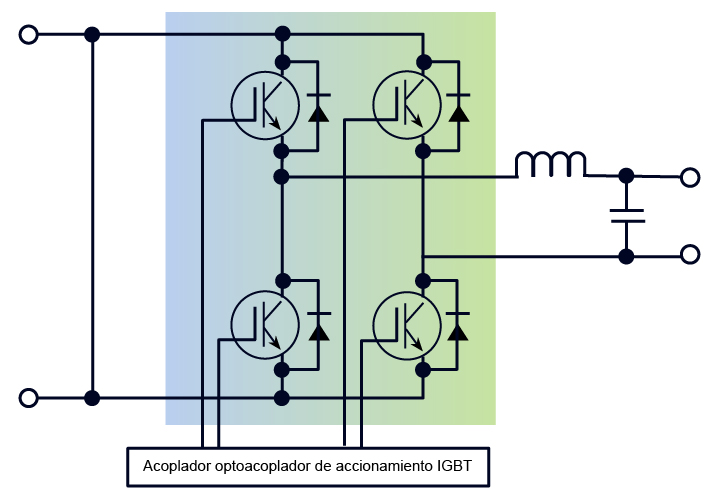
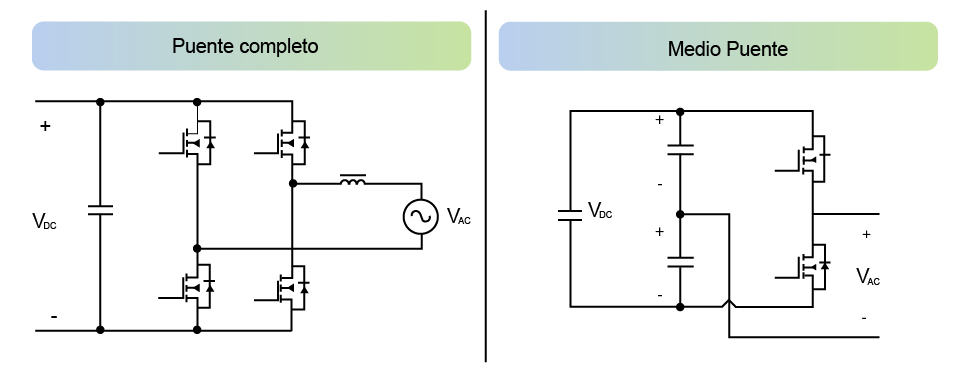
In a full-bridge inverter, each output phase (in a three-phase system) requires switching between positive and negative polarity. This topology is ideal for high capacity applications as it offers several key advantages:
- Higher output quality: Provides a smoother and more stable waveform, with lower harmonic distortion (THD).
- Increased load handling capacity: It can handle larger loads efficiently due to its robust design.
- Precise control: Allows better control over the frequency and amplitude of the AC output, which is crucial for industrial or mission-critical applications.
This type of inverter is commonly used in high capacity UPS due to its efficiency and ability to generate a stable and high quality AC output.
Half Bridge Inverter
The half-bridge inverter uses a simpler and more economical topology compared to the full-bridge inverter. It is ideal for smaller capacity applications, such as small and medium power UPS. However, it has limitations in terms of wave quality and load handling capability compared to full-bridge inverters. Despite this, half-bridge inverters are more cost-effective and have a simpler design, making them ideal for applications where power demands are moderate.
UPS with Midpoint Battery Bank
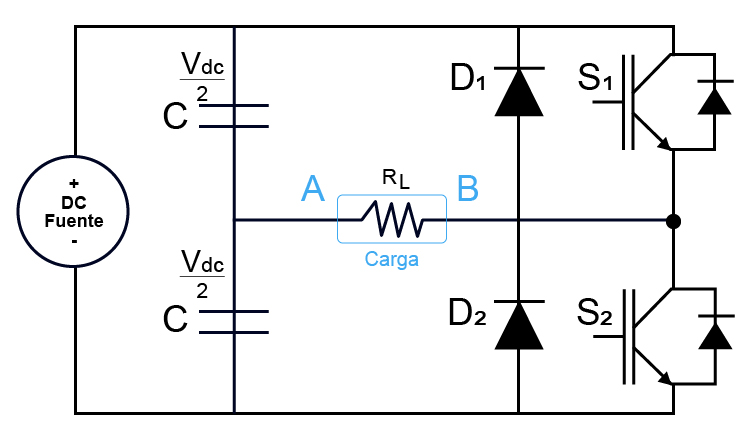
In some UPSs, especially those using a mid-point battery bank, the inverter topology can be either half-bridge or full-bridge. In a mid-point battery bank, you have a positive and negative voltage with respect to a neutral point. This design allows the inverter to work more efficiently, as it has a balanced DC bus and can generate a more stable AC waveform.
- Half Bridge Inverter: Requires a midpoint battery bank to provide the necessary symmetry in power conversion.
- Full Bridge Inverter: Although it uses a more complex design, it can also work with mid-point battery banks to generate a more stable and accurate AC output, which is ideal in more demanding applications.
Conclusion
The choice between a full-bridge inverter and a half-bridge inverter depends primarily on the UPS capacity and the specific needs of the load. Full-bridge inverters are preferred in higher power applications and where high quality output is required, while half-bridge inverters are more common in smaller capacity systems due to their lower cost and simplicity. However, both types of inverters can be adapted to work with a mid-point battery bank, allowing for efficient and stable power conversion.